The Trip That Changed Us: Jordan with My Favourite People

“Should We Actually Do This?”
That was Zara, our group chat skeptic, three months before the trip. We’d been talking about traveling together for years. Me, Zara, her husband Tariq, my best friend Amina, and Amina’s brother Yusuf. The ones who always say “next year” and then let life happen instead.
But this time felt different. Jordan kept coming up. The history. The sacred ground. The sheer scale of adventure packed into one small country. So we stopped talking and booked with Islamic Travel, and five people who’d never managed to leave the country together came home nine days later completely changed.
Standing Where Prophets Stood
Our first real stop was Mount Nebo, and I’ll be honest. I thought it would be a quick photo and lunch.
Instead, we stood there for forty minutes without anyone checking their phone.
This is where Prophet Musa (عليه السلام) stood and gazed upon the Promised Land he would never enter. Our guide told the story slowly, and Tariq, who never gets emotional, went completely quiet. Zara reached for his hand without saying a word.
Yusuf teaches Islamic studies at home. He’d taught this story dozens of times. “Standing here though,” he said, “completely different.”
We took the group selfie (Amina insisted on three angles for “optimal lighting”), but nobody rushed away. The view stretched toward Jerusalem, the Dead Sea shimmering far below. For once, none of us were rushing. We just stood together and thought about how small our problems actually were.
Then Zara broke the silence: “Okay, can we get falafel after this?”
Balance restored.
We also visited the Cave of the Seven Sleepers, the Ahl Al-Kahf that we recite from Surah Al-Kahf every single Friday. Yusuf nearly lost it. “This is literally THE cave.” Amina noted that waking up 300 years later would mean your entire playlist is outdated. We laughed, but something deeper settled in. The story stopped being something we recited. It became real people, young and afraid, trusting Allah when everything looked hopeless.
Later that night, Yusuf admitted he’d been stressing about things that won’t matter in three weeks, let alone three centuries. Deep. Very Yusuf.
The Companions Who Changed History
Nothing in Jordan hits quite like visiting the shrines of the Sahabah (رضي الله عنهم). These weren’t abstract historical figures anymore. They were men we stood next to, in the places they gave everything.
At Al-Mazar in Kerak, we visited the martyrs of the Battle of Mu’tah, where 3,000 Muslims faced a Roman army of 200,000. Our guide described how Jafar ibn Abi Talib (رضي الله عنه) held the banner aloft even after both arms were severed, refusing to let it fall. We stood there speechless.
Zara whispered, “And I complain when my Amazon order is late.”
Tariq nodded. “Perspective.”
We walked the shrines of Zaid ibn Haritha and Abdullah ibn Rawahah quietly, respectfully, feeling the weight of what happened on that ground. Then later in the Jordan Valley, the tombs of Abu Ubaidah ibn al-Jarrah, Shurahbil ibn Hasanah, and Dirar ibn al-Azwar. Men who carried Islam across entire regions.
At dinner that night, Yusuf raised his tea: “To doing hard things even when you’re not guaranteed to win.”
We also drove out to Umm Qais for the Battle of Yarmouk, where in 636 CE, 40,000 Muslims defeated a Byzantine force of 200,000 across rolling hills and open valleys. Watching the sunset from that hillside, knowing what happened there, was one of the quietest and most powerful moments of the whole trip.
The Family Lunch Nobody Expected to Be the Best Memory
Islamic Travel arranged lunch with a Jordanian family, and we weren’t sure what to expect. Would it feel forced? Touristy?
The moment Um Khalid opened the door and pulled us all into hugs before we even crossed the threshold, we had our answer.
She sat us on floor cushions, handed us food before we could ask, and kept piling more on our plates throughout the meal. The mansaf was home-cooked from scratch. Rice so fluffy it dissolved. Lamb falling apart. A jameed sauce rich and tangy in a way that made every restaurant version back home seem like a rough sketch.
Tariq, who is absolutely not skinny: “I love it here.”
When we left, Um Khalid hugged each of us like she was sending her own kids off. “You come back, yes? You are family now.”
We weren’t out of the driveway before Amina started crying. “I miss them already.”
This is what travel is supposed to feel like.
Desert, Red Sea, Canyons, and Pure Chaos
The adventures kept stacking up.
In Wadi Rum, we did a three-hour 4×4 jeep safari through landscapes that looked straight out of a science fiction film. Towering sandstone cliffs, ancient Nabatean carvings, Lawrence of Arabia’s well. At sunset, we rode camels as the desert turned orange, then pink, then deep purple. Amina declared it majestic. Zara declared it uncomfortable. Yusuf was already posting to Instagram.
That night in a Bedouin camp under a sky packed with stars, Zara asked: “When was the last time we all just stopped?” Nobody had a quick answer.

Down in Aqaba, we jumped on a boat for two hours of snorkeling in the Red Sea. Coral reefs in every colour, fish weaving through the turquoise water. After days of deep historical immersion, floating above that underwater world felt like the perfect reset.
Then came Wadi Al-Mujib. The Siq Trail is a wet canyon hike through towering sandstone walls, wading through pools, scrambling over rocks, following a river toward a waterfall at the end. Zara threatened to turn back twice. She didn’t. The look on her face at the waterfall made the whole thing worth it.
Petra: The Rose-Red City
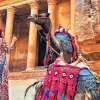
Petra needs no build-up. We rode horses to the entrance, walked through the Siq, and then the Treasury appeared at the end of the gorge, carved from rose-red rock, glowing in morning light.
All five of us stopped dead.
“That’s real?!”
We spent six hours wandering. Climbing tombs, finding hidden corners, walking through a Roman theater still standing after two thousand years. Yusuf said SubhanAllah every ten minutes. Nobody counted.
The Dead Sea: Pure, Unfiltered Joy
At the Dead Sea the next morning, we floated effortlessly in mineral-rich water at 430 metres below sea level. Tariq tried to stand up and immediately flipped backward. Zara covered herself in therapeutic mud and declared herself a wellness influencer. Yusuf tried to dive under (you can’t) and surfaced laughing. Pure, unfiltered joy after days of genuine depth.
Why Islamic Travel Made All the Difference
We could have planned this ourselves. Booked flights. Found hotels. Googled shrines.
But we would have missed so much.
Islamic Travel understood what Muslim travellers actually need. Prayer times were built into the itinerary, not squeezed in as an afterthought. Every meal was certified halal with no anxiety about ingredients. Our guide knew the Islamic history of every site at a level far beyond the tourist version. The family lunch, the Yarmouk sunset dinner, the Bedouin camp under the stars. These weren’t generic add-ons. They were the heart of the experience.
For a group with five different preferences (Zara wanted the beach, Yusuf wanted the history, Tariq wanted the food, Amina wanted the photos, and I just wanted everyone to stop arguing about where to eat), that kind of seamless planning was genuinely priceless.
On the flight home, we scrolled through hundreds of photos. Sacred shrines, desert sunsets, Petra at dawn, Dead Sea chaos, the family that welcomed us like their own.
But the photos didn’t capture the real stuff. The late-night conversations about faith and purpose. The inside jokes that formed. The moments we stopped talking and just felt something together.
Amina put her head on my shoulder. “We have to do this again.”
Zara, half-asleep: “Agreed. Better shoes next time.”
Tariq: “More mansaf.”
Yusuf: “Fewer stairs.”
We landed tired, sun-kissed, and genuinely transformed. Not in some dramatic way. Just softer. More grateful. More connected to our faith, to Islamic history, and to each other.
Jordan travel for Muslims is not just a vacation. It is a journey that deepens your faith, strengthens your friendships, and creates memories you carry long after you land back in Australia.
Visit www.islamictravel.com.au to explore Jordan tour packages, halal-friendly itineraries, and group travel options. Islamic Travel takes care of everything so you can focus on what actually matters.
Jordan will be waiting. And honestly? We’re already planning the next one.
Even if Zara complains about the stairs the entire time.
Halal-Friendly Travel in Jordan
Jordan is one of the most welcoming countries in the world for Muslim travellers. Here is what to expect on the ground.
Halal Dining and Food
As a Muslim-majority country, Jordan makes halal dining completely effortless. Every restaurant, hotel, and street vendor serves halal food without needing to ask.
Must-try dishes:
- Mansaf: Slow-cooked lamb in jameed sauce over rice (Jordan’s national dish)
- Maqluba: Upside-down rice dish
- Fresh falafel: Available everywhere
- Knafeh: Sweet cheese pastry
- Zarb: Bedouin barbecue cooked underground in Wadi Rum
Islamic Travel includes verified halal meals throughout the itinerary, including that unforgettable home-cooked family lunch, so there is never any anxiety about ingredients or sourcing.
Prayer Facilities and Mosques
Mosques are abundant across Jordan, from Amman’s iconic King Abdullah Mosque to small neighbourhood masjids in every town. Prayer areas are common at major tourist sites including Petra and Jerash. Hotels provide prayer mats and Qibla direction as standard. Islamic Travel builds prayer times directly into the daily itinerary so nothing is rushed or missed.
Muslim-Friendly Accommodation
Hotels on this tour are selected with Muslim travellers in mind:
- Prayer mats provided
- Qibla direction markers
- Halal breakfast spreads as standard
- 5-star property in Amman
- Authentic Bedouin camp in Wadi Rum (comfortable yet authentic)
Cultural Sensitivity and Community Connections
Jordanians are warm, hospitable, and deeply respectful of Islamic values. The lunch with a Jordanian family arranged by Islamic Travel goes well beyond sightseeing. It is genuine connection, sitting on floor cushions, eating from the same pot, and being welcomed as family.
Dress code: Dress modestly throughout the trip, covering shoulders and knees. Women are not required to wear a headscarf except when entering mosques.
Language and Communication
Arabic is the official language, but English is widely spoken in tourist areas, hotels, and restaurants. Our Islamic Travel guide handled everything in between, including explaining the Islamic historical significance of each site in a way that went far beyond what a standard tour would offer.
Practical Travel Tips for Australian Muslims
Visa and Entry
Australians can purchase a Jordan Pass online before departure. It covers the visa fee and includes entry to Petra and over 40 other sites. Visas are also available on arrival at Queen Alia International Airport in Amman.
Currency and Payments
Jordan uses the Jordanian Dinar (JOD). Credit cards are widely accepted in cities and tourist areas. Carry some cash for smaller vendors, souks, and tipping.
Best Time to Visit
Spring (March to May) and autumn (September to November): Most comfortable temperatures for hiking and sightseeing
Summer: Very hot, particularly in Wadi Rum and Aqaba
Winter: Mild but can be cold in the highlands around Amman and Petra
Getting Around
Islamic Travel handles all transfers and transport throughout the tour, including:
- Airport pickups
- Inter-city travel
- Wadi Rum jeep safari
- No car hire needed
Safety
Jordan is consistently rated one of the safest countries in the Middle East for international visitors. Standard travel awareness applies, but the country has a well-established tourism infrastructure and a reputation for genuine hospitality.